User:SysopJ/My sandbox: Difference between revisions
No edit summary |
|||
| (96 intermediate revisions by 2 users not shown) | |||
| Line 1: | Line 1: | ||
'''Irving Kane Pond''' (1857-1939) and his brother Allen Bartlitt Pond (1858–1929) | |||
== | == Personal life == | ||
[[File:Irving_Kane_Pond,_1876.jpg|200px|left|thumb|Irving Kane Pond, 1876]] | |||
== Architectural work == | |||
=== Training and early work === | |||
=== Philosophy and style === | |||
<blockquote> | <blockquote> | ||
The Ponds sought to create a modern American architecture without rejecting architectural stylistic traditions, but simplifying them through the emphasis of geometry and the inherent quality of building materials and construction. In that regard, the Ponds were strongly influenced by the Arts and Crafts movement, with the emphasis on honest materials used honestly.<ref>David Swan, Preface to ''The Autobiography of Irving K. Pond: The Sons of Mary and Eliihu'' ed.David Swan and Terry Tatum (Oak Park, Ill: The Hyoogen Press, 2009), vii.</ref> | |||
</blockquote> | </blockquote> | ||
Strong sense of social responsibility ..... | |||
<blockquote> | <blockquote> | ||
Stylistically Irving Pond did not totally fit in one category or another. He stood in the role of an intermediary, halfway between the revolutionary aesthetics and technology of the Chicago School and the Prairie School and the taste for traditional architecture his clients often felt that precedent or literary aesthetics required. His architecture used traditional materials especially brick and employed traditional forms such as gable roofs, but his designs embraced a geometric simplicity with no embellishments — a tenet of the Arts & Crafts movement.<ref>from Ravinia School nomination ..... </ref> | |||
</blockquote> | </blockquote> | ||
The | === Participation in architectural organizations === | ||
=== Gallery of architectural projects === | |||
'''The L. W. Rogers Building and similar structures''' | |||
[[File:Rogers_Building_1a.jpg|center|400px|thumb|L. W. Rogers Building, 1926]] | |||
<gallery widths="200px" perrow="4"> | |||
File:MIchigan Union, 1919.png|Michigan Union, 1919 | |||
File:Purdue Memorial Union, 1924.JPG||Purdue Memorial Union, 1924 | |||
File:Kansas Memorial Union, 1927.png|Kansas Memorial Union, 1927 | |||
File:Michigan League, 1929.jpg|Michigan League, 1929 | |||
</gallery> | |||
'''Examples of other buildings''' | |||
<gallery widths=" | <gallery widths="200px" perrow="4"> | ||
File: | File:Highland Park Club House..png|Highland Park Club House, 1891 | ||
File:Oregon Public Library.jpg|Oregon Public Library, 1909 | |||
File: | File:Manor House Kenosha.jpg|Manor House, Kenosha, WI, 1926 | ||
File: | |||
</gallery> | </gallery> | ||
== Other activities == | |||
Chicago Literary Club | |||
Hull-House | |||
=== Circus and acrobatics === | |||
=== Social clubs and memberships === | |||
== Writings == | |||
=== | * '''''The Meaning Of Architecture: An Essay In Constructive Criticism'''''. Boston, Marshall Jones Company, 1918. 226 pages, illustrations. Available at [https://catalog.hathitrust.org/api/volumes/oclc/971540.html Hathitrust] and several versions at [https://archive.org/details/meaningofarchite00pond Internet Archive]. A historical reproduction of the 1923 edition is available at [https://www.amazon.com/meaning-architecture-essay-constructive-criticism/dp/1117177548 Amazon.com]. | ||
* '''"Eliel Saarinen and his work a word of appreciation and greeting"'''. 1923. Available at [https://books.google.com/books?id=bctPAAAAMAAJ and [https://babel.hathitrust.org/cgi/pt?id=mdp.39015008062880&seq=1 Hathitrust]. Pages extracted from ''The Western Architect'' 32 no. 7 (July, 1923): 75-76 plus plates. | |||
* '''''A Day Under the Big Top, a Study in Life and Art'''''. Chicago: Chicago Literary Club, 1924. 40 pages, with 4 diagrams. "Edition, five hundred and fifteen copies, printed for members of the club in the month of March, nineteen hundred and twenty-four." About circus and acrobatics. Available at [https://books.google.com/books?id=tWB0SUDY1JoC Google Books] and [https://babel.hathitrust.org/cgi/pt?id=mdp.39015062226652&seq=7 Hathitrust]. | |||
* '''''The College Union'''''. [New York], 1931. 16 pages. Limited availability at [https://babel.hathitrust.org/cgi/pt?id=mdp.39015004162973 Hathitrust] and [https://books.google.com/books?id=a_fVAAAAMAAJ Google Books]. | |||
* '''"Pullman - America's First Planned Industrial Town"'''. Illinois society of architects. ''Monthly bulletin'' vol. 18-19, nos. 12-1, June-July, 1934. 6-8 pages. | |||
* '''''Big Top Rhythms: A Study in Art and Life''''', written and illustrated by Pond. Chicago, New York, Willett, Clark and Company, 1937. 229 pages, illustrations. | |||
* '''''A Strange Fellow, and Other Club Papers''''', written and illustrated by Pond New York, Chicago, Priv. Print. by Willett, Clark and Company, 1938. 224 pages, illustrations. Available at [https://catalog.hathitrust.org/api/volumes/oclc/2976903.html Hathitrust], [https://libsysdigi.library.illinois.edu/OCA/Books2012-05/strangefellowoth00ilpond/ Open Content Alliance], and [https://archive.org/details/strangefellowoth00ilpond Internet Archive]. | |||
* '''''The Autobiography of Irving K. Pond''''', written in the 1930s and published posthumously. Edited by Terry Tatum and David Swan. Oak Park, IL: Hyoogen Press, 2009. | |||
== Additional resources == | |||
=== Articles === | |||
</ | * Szuberla, Guy. "Irving Kane Pond: a Michigan Architect in Chicago" ''Old Northwest'' 5 no. 2 (Summer, 1979): 109-140. | ||
=== Books === | |||
* Pond, Irving Kane. '''''The Autobiography of Irving K. Pond: The Sons of Mary and Elihu''''' ed.David Swan and Terry Tatum. Oak Park, Ill: The Hyoogen Press, 2009. | |||
=== Archival collections === | |||
* '''The University of Michigan Bentley Historical Library'''. | |||
** [https://findingaids.lib.umich.edu/catalog/umich-bhl-852090 Pond Family Papers, 1841-1939]. "Correspondence of Elihu B. Pond, editor of Michigan Argus, his sons, Chicago architects, Irving Kane and Allen Bartlit Pond, founders of firm of Pond & Pond, and other family members; include materials concerning family affairs, architectural projects, Jane Addams and the work of Hull House, European travels, politics especially as relates to period of the Civil War and the election of 1896; also photographs, architectural drawings and other visual materials." | |||
* '''The Art Institute of Chicago: Ryerson and Burnham Art and Architecture Archives''', Chicago, Illinois. | |||
** [https://www.artic.edu/artworks/262324/pond-and-pond-collection Pond and Pond Collection, c.1895-1938]. "Correspondence, albums, black and white photographic prints, architectural drawings, and architectural reprographic prints." | |||
* '''The Newberry Library - Modern Manuscripts''', Chicago, Illinois. | |||
** [https://explore.chicagocollections.org/ead/newberry/72/xw4 American Circus Collection, 1891-1939]. "Late 19th and early 20th century circus and theater related illustrations, publicity, programs, photographs and memorabilia" donated by Irving Kane Pond, 1939. | |||
** [https://archives.newberry.org/repositories/2/resources/398 Chicago Literary Club records]. Irving Kane Pond was active in this club, and its records include "weekly papers read by over 250 members, but also correspondence, minutes, a visitors' register, cashbook, and scrapbooks." | |||
* '''Columbia University Avery Architectural and Fine Arts Library''', New York. | |||
** [https://findingaids.library.columbia.edu/pdf/cul-3460598.pdf Bertram Grosvenor Goodhue architectural drawings and papers 3460598]. Materials related to Irving Kane Pond, Claude Bragdon, and many other architects. | |||
* '''Library of Congress Prints & Photographs Online Catalog''' Historic American Buildings Survey, Engineering Record, Landscapes Survey, Washington DC. | |||
** [https://www.loc.gov/pictures/item/il1014/ Junior League of Chicago, 1447 North Astor Street, Chicago, Cook County, IL] | |||
* '''The Athenaeum of Philadelphia''', Philadelphia, PA. | |||
** [https://archives.philaathenaeum.org/agents/people/116 Pond, Irving K. (Irving Kane), 1857-1939]. "Correspondence to Seeler from architects, designers, and/or members of theAmerican Institute of Architects, both in Boston and Washington DC." | |||
== Notes == | |||
<references/> | |||
[[Category:Architects|Pond, Irving Kane]] | |||
[[Category:Writers|Pond, Irving Kane]] | |||
[[Category:Nationality American|Pond, Irving Kane]] | |||
[[Category:People|Pond, Irving Kane]] | |||
Latest revision as of 18:40, 19 May 2026
Irving Kane Pond (1857-1939) and his brother Allen Bartlitt Pond (1858–1929)
Personal life

Architectural work
Training and early work
Philosophy and style
The Ponds sought to create a modern American architecture without rejecting architectural stylistic traditions, but simplifying them through the emphasis of geometry and the inherent quality of building materials and construction. In that regard, the Ponds were strongly influenced by the Arts and Crafts movement, with the emphasis on honest materials used honestly.[1]
Strong sense of social responsibility .....
Stylistically Irving Pond did not totally fit in one category or another. He stood in the role of an intermediary, halfway between the revolutionary aesthetics and technology of the Chicago School and the Prairie School and the taste for traditional architecture his clients often felt that precedent or literary aesthetics required. His architecture used traditional materials especially brick and employed traditional forms such as gable roofs, but his designs embraced a geometric simplicity with no embellishments — a tenet of the Arts & Crafts movement.[2]
Participation in architectural organizations
Gallery of architectural projects
The L. W. Rogers Building and similar structures

-
 Michigan Union, 1919
 -
 Purdue Memorial Union, 1924
 -
 Kansas Memorial Union, 1927
 -
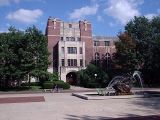 Michigan League, 1929


Examples of other buildings
-
 Highland Park Club House, 1891
 -
 Oregon Public Library, 1909
 -
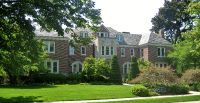 Manor House, Kenosha, WI, 1926


Other activities
Chicago Literary Club Hull-House
Circus and acrobatics
Social clubs and memberships
Writings
- The Meaning Of Architecture: An Essay In Constructive Criticism. Boston, Marshall Jones Company, 1918. 226 pages, illustrations. Available at Hathitrust and several versions at Internet Archive. A historical reproduction of the 1923 edition is available at Amazon.com.
- "Eliel Saarinen and his work a word of appreciation and greeting". 1923. Available at and [https://babel.hathitrust.org/cgi/pt?id=mdp.39015008062880&seq=1 Hathitrust. Pages extracted from The Western Architect 32 no. 7 (July, 1923): 75-76 plus plates.
- A Day Under the Big Top, a Study in Life and Art. Chicago: Chicago Literary Club, 1924. 40 pages, with 4 diagrams. "Edition, five hundred and fifteen copies, printed for members of the club in the month of March, nineteen hundred and twenty-four." About circus and acrobatics. Available at Google Books and Hathitrust.
- The College Union. [New York], 1931. 16 pages. Limited availability at Hathitrust and Google Books.
- "Pullman - America's First Planned Industrial Town". Illinois society of architects. Monthly bulletin vol. 18-19, nos. 12-1, June-July, 1934. 6-8 pages.
- Big Top Rhythms: A Study in Art and Life, written and illustrated by Pond. Chicago, New York, Willett, Clark and Company, 1937. 229 pages, illustrations.
- A Strange Fellow, and Other Club Papers, written and illustrated by Pond New York, Chicago, Priv. Print. by Willett, Clark and Company, 1938. 224 pages, illustrations. Available at Hathitrust, Open Content Alliance, and Internet Archive.
- The Autobiography of Irving K. Pond, written in the 1930s and published posthumously. Edited by Terry Tatum and David Swan. Oak Park, IL: Hyoogen Press, 2009.
Additional resources
Articles
- Szuberla, Guy. "Irving Kane Pond: a Michigan Architect in Chicago" Old Northwest 5 no. 2 (Summer, 1979): 109-140.
Books
- Pond, Irving Kane. The Autobiography of Irving K. Pond: The Sons of Mary and Elihu ed.David Swan and Terry Tatum. Oak Park, Ill: The Hyoogen Press, 2009.
Archival collections
- The University of Michigan Bentley Historical Library.
- Pond Family Papers, 1841-1939. "Correspondence of Elihu B. Pond, editor of Michigan Argus, his sons, Chicago architects, Irving Kane and Allen Bartlit Pond, founders of firm of Pond & Pond, and other family members; include materials concerning family affairs, architectural projects, Jane Addams and the work of Hull House, European travels, politics especially as relates to period of the Civil War and the election of 1896; also photographs, architectural drawings and other visual materials."
- The Art Institute of Chicago: Ryerson and Burnham Art and Architecture Archives, Chicago, Illinois.
- Pond and Pond Collection, c.1895-1938. "Correspondence, albums, black and white photographic prints, architectural drawings, and architectural reprographic prints."
- The Newberry Library - Modern Manuscripts, Chicago, Illinois.
- American Circus Collection, 1891-1939. "Late 19th and early 20th century circus and theater related illustrations, publicity, programs, photographs and memorabilia" donated by Irving Kane Pond, 1939.
- Chicago Literary Club records. Irving Kane Pond was active in this club, and its records include "weekly papers read by over 250 members, but also correspondence, minutes, a visitors' register, cashbook, and scrapbooks."
- Columbia University Avery Architectural and Fine Arts Library, New York.
- Bertram Grosvenor Goodhue architectural drawings and papers 3460598. Materials related to Irving Kane Pond, Claude Bragdon, and many other architects.
- Library of Congress Prints & Photographs Online Catalog Historic American Buildings Survey, Engineering Record, Landscapes Survey, Washington DC.
- The Athenaeum of Philadelphia, Philadelphia, PA.
- Pond, Irving K. (Irving Kane), 1857-1939. "Correspondence to Seeler from architects, designers, and/or members of theAmerican Institute of Architects, both in Boston and Washington DC."