De Stijl and Neoplasticism: Difference between revisions
No edit summary |
No edit summary |
||
| (4 intermediate revisions by one other user not shown) | |||
| Line 1: | Line 1: | ||
'''De Stijl''' (1917-1931) was a Dutch art movement that focused on pure abstraction (Neoplasticism) to capture the underlying harmony of the universe in art, architecture, and design using geometric forms, primary colors, and straight lines. | |||
De Stijl (1917-1931) was a Dutch art movement that focused on pure abstraction (Neoplasticism) to capture the underlying harmony of the universe in art, architecture, and design using geometric forms, primary colors, and straight lines. | |||
==The Components== | ==The Components== | ||
| Line 10: | Line 6: | ||
</ref> | </ref> | ||
'''Neoplasticism''' was the artistic style defined by Piet Mondrian and used by members of the De Stijl movement. The core principles were: | '''Neoplasticism''' was the artistic style defined by [[Piet Mondrian]] and used by members of the De Stijl movement. The core principles were: | ||
* Pure Abstraction - Elimination of natural forms to express the spiritual and universal in art and design | * Pure Abstraction - Elimination of natural forms to express the spiritual and universal in art and design | ||
| Line 25: | Line 21: | ||
'''Theo van Doesburg''' (1883 - 1931) — Painter, principal founder and publisher of De Stijl journal who wrote about art theory synthesizing science and mysticism as well as the fourth dimension.<ref>"Chronologies: Artists and the Spiritual", Judi Freeman, The Spiritual in Art: Abstract Painting 1890-1985, as organized by Maurice Tuchman, Los Angeles County Museum of Art, p. 397.}</ref> | '''Theo van Doesburg''' (1883 - 1931) — Painter, principal founder and publisher of De Stijl journal who wrote about art theory synthesizing science and mysticism as well as the fourth dimension.<ref>"Chronologies: Artists and the Spiritual", Judi Freeman, The Spiritual in Art: Abstract Painting 1890-1985, as organized by Maurice Tuchman, Los Angeles County Museum of Art, p. 397.}</ref> | ||
'''Piet Mondrian''' (1872 -1944) — Painter who defined and adhered to Neoplasticism, utilizing gray, white, and primary colors (red, blue, and yellow) in a grid like pattern with black lines. Coined the term Nieuwe Beelding (Neoplasticism) in 1917. He wrote 12 articles about Neoplasticism in painting which were published in De Stijl and also published a [https://digi.ub.uni-heidelberg.de/diglit/mondrian1920/0005/image,info book] in 1920.<ref>See https://en.wikipedia.org/wiki/De_Stijl </ref> | '''[[Piet Mondrian]]''' (1872 -1944) — Painter who defined and adhered to Neoplasticism, utilizing gray, white, and primary colors (red, blue, and yellow) in a grid like pattern with black lines. Coined the term Nieuwe Beelding (Neoplasticism) in 1917. He wrote 12 articles about Neoplasticism in painting which were published in De Stijl and also published a [https://digi.ub.uni-heidelberg.de/diglit/mondrian1920/0005/image,info book] in 1920.<ref>See https://en.wikipedia.org/wiki/De_Stijl </ref> | ||
'''Bart van der Leck''' (1876 - 1958) - Painter and designer focused on color and form. He began his career in stained glass and then moved towards abstraction. When his abstract style started to be based on representational forms, he broke with the group. In 1920, after he left the group, he went back to figurative compositions.<ref>“The Birth of De Stijl, Part II, Bart van der Leck”, Rudolf W. Oxennar, https://www.artforum.com/features/the-birth-of-de-stijl-part-two-bart-van-der-leck-210291/ </ref> | '''Bart van der Leck''' (1876 - 1958) - Painter and designer focused on color and form. He began his career in stained glass and then moved towards abstraction. When his abstract style started to be based on representational forms, he broke with the group. In 1920, after he left the group, he went back to figurative compositions.<ref>“The Birth of De Stijl, Part II, Bart van der Leck”, Rudolf W. Oxennar, https://www.artforum.com/features/the-birth-of-de-stijl-part-two-bart-van-der-leck-210291/ </ref> | ||
| Line 58: | Line 54: | ||
==Influence of Theosophy== | ==Influence of Theosophy== | ||
There were strong ties between Theosophy and Dutch art from 1890 to 1920. As early as 1895, esoteric concepts of mathematics were being used in certain Dutch artistic/theosophical circles. Two painters, Jacob Bendien and Jan van Deere, are believed to be the first to initiate abstract art in the Netherlands before the de Stijl movement began. Bendien had links to Theosophy, studying with theosophical painter Cornelis Spoor and developing a friendship with Piet Mondrian, writing articles addressing Mondrian’s Neoplastic work which was influenced by Theosophy and rooted in esoteric concepts of mathematics.<ref>"Annunciation of the New Mysticism: Dutch Symbolism and Early Abstraction", Carel Blotkamp, Spiritual in Art: Abstract Painting 1890-1985, as organized by Maurice Tuchman, Los Angeles County Museum of Art, p. 104-105.</ref> | There were strong ties between [[Theosophy]] and Dutch art from 1890 to 1920. As early as 1895, esoteric concepts of mathematics were being used in certain Dutch artistic/theosophical circles. Two painters, Jacob Bendien and Jan van Deere, are believed to be the first to initiate abstract art in the Netherlands before the de Stijl movement began. Bendien had links to Theosophy, studying with theosophical painter Cornelis Spoor and developing a friendship with Piet Mondrian, writing articles addressing Mondrian’s Neoplastic work which was influenced by Theosophy and rooted in esoteric concepts of mathematics.<ref>"Annunciation of the New Mysticism: Dutch Symbolism and Early Abstraction", Carel Blotkamp, Spiritual in Art: Abstract Painting 1890-1985, as organized by Maurice Tuchman, Los Angeles County Museum of Art, p. 104-105.</ref> | ||
Theo van Doesburg, who was introduced to Theosophy from his first wife, was heavily influenced by the work of Wassily Kandinsky and M.H.J. Schoenmaekers.<ref>"Chronologies: Artists and the Spiritual", Judi Freeman, The Spiritual in Art: Abstract Painting 1890-1985, as organized by Maurice Tuchman, Los Angeles County Museum of Art, p. 397.</ref> In 1918, he asked Mondrian if Schoenmaekers books had been of any use to him. Mondrian said, “I got everything from the Secret Doctrine (Blavatsky), not from Schoenm., although he says the same things.”<ref>Letter from Mondrian to van Doesburg, n.d., probably May 1918, quoted in Hoek, “Piet Mondrian”, p. 59 as cited in Carel Blotkamp's "Annunciation of the New Mysticism: Dutch Symbolism and Early Abstraction", The Spiritual in Art: Abstract Painting 1890-1985, as organized by Maurice Tuchman, Los Angeles County Museum of Art, p. 103</ref> For Mondrian, art was, “…a conduit between the microcosm of earthly existence and the macrocosm of everlasting spiritual existence.”<ref>"Sacred Geometry: French Symbolism and Early Abstraction", Robert P. Welsh, The Spiritual in Art: Abstract Painting 1890-1985, as organized by Maurice Tuchman, Los Angeles County Museum of Art, p. 84.</ref> | Theo van Doesburg, who was introduced to Theosophy from his first wife, was heavily influenced by the work of [[Wassily Kandinsky]] and M.H.J. Schoenmaekers.<ref>"Chronologies: Artists and the Spiritual", Judi Freeman, The Spiritual in Art: Abstract Painting 1890-1985, as organized by Maurice Tuchman, Los Angeles County Museum of Art, p. 397.</ref> In 1918, he asked Mondrian if Schoenmaekers books had been of any use to him. Mondrian said, “I got everything from the Secret Doctrine (Blavatsky), not from Schoenm., although he says the same things.”<ref>Letter from Mondrian to van Doesburg, n.d., probably May 1918, quoted in Hoek, “Piet Mondrian”, p. 59 as cited in Carel Blotkamp's "Annunciation of the New Mysticism: Dutch Symbolism and Early Abstraction", ''The Spiritual in Art: Abstract Painting 1890-1985'', as organized by Maurice Tuchman, Los Angeles County Museum of Art, p. 103.</ref> For Mondrian, art was, “…a conduit between the microcosm of earthly existence and the macrocosm of everlasting spiritual existence.”<ref>"Sacred Geometry: French Symbolism and Early Abstraction", Robert P. Welsh, ''The Spiritual in Art: Abstract Painting 1890-1985'', as organized by Maurice Tuchman, Los Angeles County Museum of Art, p. 84.</ref> | ||
==Falling Apart== | ==Falling Apart== | ||
Although De Stijl was founded on Neoplasticism as originally defined by Mondrian, the group evolved to encompass other elements as some artists and architects left and others joined. Many of the members had strong feelings about the work of other members and rifts started to develop. For example, on September 5, 1920 Mondrian wrote to van Doesburg complaining that Vantongerloo was going about his work as an "ordinary" Theosophist whereas Oud was steeped in Neoplasticism.<ref>Mondrian: His Life, His Art, His Quest for the Absolute, Nicholas Fox Weber, New York, 2024, Alfred A. Knopf Publisher, p. 226</ref> He would criticize Oud a few months later. In 1924, Mondrian and van Doesburg went their separate ways after van Doesburg started using slanted lines in his work.<ref>Mondrian: His Life, His Art, His Quest for the Absolute, Nicholas Fox Weber, New York, 2024, Alfred A. Knopf Publisher, p. 261</ref>. Theo van Doesburg, who had been the force behind the De Stijl journal, passed away in 1931. The last issue of De Stijl was published in 1932. | Although De Stijl was founded on Neoplasticism as originally defined by Mondrian, the group evolved to encompass other elements as some artists and architects left and others joined. Many of the members had strong feelings about the work of other members and rifts started to develop. For example, on September 5, 1920 Mondrian wrote to van Doesburg complaining that Vantongerloo was going about his work as an "ordinary" Theosophist whereas Oud was steeped in Neoplasticism.<ref>Mondrian: His Life, His Art, His Quest for the Absolute, Nicholas Fox Weber, New York, 2024, Alfred A. Knopf Publisher, p. 226</ref> He would criticize Oud a few months later. In 1924, Mondrian and van Doesburg went their separate ways after van Doesburg started using slanted lines in his work.<ref>''Mondrian: His Life, His Art, His Quest for the Absolute'', Nicholas Fox Weber, New York, 2024, Alfred A. Knopf Publisher, p. 261.</ref>. Theo van Doesburg, who had been the force behind the De Stijl journal, passed away in 1931. The last issue of De Stijl was published in 1932. | ||
==Gallery== | ==Gallery== | ||
| Line 78: | Line 74: | ||
==Additional Resources== | ==Additional Resources== | ||
Museum Collections | '''Museum Collections''' | ||
[https://www.kunstmuseum.nl/en/search?search=mondrian Kunstmuseum Hague] has the most extensive Mondrian collection | [https://www.kunstmuseum.nl/en/search?search=mondrian Kunstmuseum Hague] has the most extensive Mondrian collection | ||
[https://www.stedelijk.nl/en Stedelijk Museum] (Amsterdam) has many works by | [https://www.stedelijk.nl/en Stedelijk Museum] (Amsterdam) has many works by Rietveld and van Doesburg | ||
[https://www.centraalmuseum.nl/en/our-collection?_gl=1*ztftlu*_up*MQ..*_ga*MTczMDY0NDIxMC4xNzcwMTM5NDUy*_ga_ZGLY9F9KH3*czE3NzAxMzk0NTAkbzEkZzAkdDE3NzAxMzk0NTAkajYwJGwwJGg0NjQ2Nzk0ODc. Central Museum of Utrecht] has the largest Rietveld collection worldwide | [https://www.centraalmuseum.nl/en/our-collection?_gl=1*ztftlu*_up*MQ..*_ga*MTczMDY0NDIxMC4xNzcwMTM5NDUy*_ga_ZGLY9F9KH3*czE3NzAxMzk0NTAkbzEkZzAkdDE3NzAxMzk0NTAkajYwJGwwJGg0NjQ2Nzk0ODc. Central Museum of Utrecht] has the largest Rietveld collection worldwide | ||
Videos | [http://Kröller-Müller%20Museumhttps://krollermuller.nl/en/bart-van-der-leck-en-helene-kroller-muller/info?_gl=1*1td1i76*_up*MQ..*_ga*MTk5MDg0MjEyOS4xNzcwMzMzNzU1*_ga_1K7PJHP114*czE3NzAzMzM3NTQkbzEkZzAkdDE3NzAzMzM3NTQkajYwJGwwJGgxNDAxNjcyMTQx Kröller-Müller Museum] has masterpieces by Mondrian, van Doesburg, Rietveld, and Van der Leck | ||
'''Videos''' | |||
De Stijl Movement: Art and Architecture Revolution, InSite YouTube channel, June 26, 2024, https://m.youtube.com/watch?v=swIZI_QUY1g | De Stijl Movement: Art and Architecture Revolution, InSite YouTube channel, June 26, 2024, https://m.youtube.com/watch?v=swIZI_QUY1g | ||
De Stijl - Piet Mondrian and Theo van Doesburg, 20th Century, Vivie’s Art World, May 14, 2025, https://www.youtube.com/watch?v=QQ8GDjoWUfY | |||
Websites | '''Websites''' | ||
Museum of Modern Art, https://www.moma.org/collection/terms/de-stijl | Museum of Modern Art, https://www.moma.org/collection/terms/de-stijl | ||
Latest revision as of 20:54, 6 February 2026
De Stijl (1917-1931) was a Dutch art movement that focused on pure abstraction (Neoplasticism) to capture the underlying harmony of the universe in art, architecture, and design using geometric forms, primary colors, and straight lines.
The Components
De Stijl (English translation "the style") was the name of the movement and the journal that was founded in 1917. At one point, De Stijl had 100 members and the publication had a circulation of 300 copies.[1]
Neoplasticism was the artistic style defined by Piet Mondrian and used by members of the De Stijl movement. The core principles were:
- Pure Abstraction - Elimination of natural forms to express the spiritual and universal in art and design
- Geometry - Use of horizontal and vertical lines, in right angles
- Colors - Use of neutral (black, white, and gray) and primary (red, blue, and yellow) colors only in work
Mission
In 1918, the group produced a manifesto with a desire to connect with universal harmony in their work. They were familiar with theosophical concepts which they promoted to further the mission of the group.[2]
Original Members
Theo van Doesburg (1883 - 1931) — Painter, principal founder and publisher of De Stijl journal who wrote about art theory synthesizing science and mysticism as well as the fourth dimension.[3]
Piet Mondrian (1872 -1944) — Painter who defined and adhered to Neoplasticism, utilizing gray, white, and primary colors (red, blue, and yellow) in a grid like pattern with black lines. Coined the term Nieuwe Beelding (Neoplasticism) in 1917. He wrote 12 articles about Neoplasticism in painting which were published in De Stijl and also published a book in 1920.[4]
Bart van der Leck (1876 - 1958) - Painter and designer focused on color and form. He began his career in stained glass and then moved towards abstraction. When his abstract style started to be based on representational forms, he broke with the group. In 1920, after he left the group, he went back to figurative compositions.[5]
Vilmos Huszar (1884 - 1960) — Hungarian artist and designer who moved to the Netherlands in 1905. He was responsible for the cover design of De Stijl and wrote numerous articles that further defined neoplasticism in De Stijl.[6]
Georges Vantongerloo (1886 - 1965) — Sculptor and painter who adhered to mathematical principles. Conveyed to sculptors the need to visualize the invisible in an article he wrote (Reflexions) for De Stijl. He also published a book, Art and its Future, in which he conducted a mathematical analysis of several Flemish paintings.[7]
J.J.P. Oud (1890 - 1963) — Dutch architect who worked on socially progressive residential projects. He collaborated with Theo van Doesburg in 1917 and then became involved in the De Stijl movement using De Stijl principles in buildings.[8]
Gerrit Rietveld (1888 - 1964) — Architect and designer who designed houses and furniture (such as the iconic Red Blue chair / Schroeder house) using De Stijl principles for his most iconic work. He broke with the group in1928, but held a De Stijl retrospective in 1951 which revived interest in his earlier works.[9]
Robert van’t Hoff (1887 - 1979) — Dutch architect and furniture designer. He wrote five articles for De Stijl over two years. He then split with the group over differences with Theo van Doesburg. He kept in touch with other De Stijl members such as J.J.P. Oud and Mondrian who he visited in 1931. He financed the final issue of De Stijl in 1932.[10]
Jan Wils (1891 - 1972) — Dutch architect and De Stijl member best known for for his design of the Olympic stadium in Amsterdam for the 1928 summer Olympics.
Antony Kok (1882 - 1969) - Poet and writer who worked closely with Theo van Doesburg in producing content for De Stijl. He personally supported fellow De Stijl members by buying works from Mondrian and van Doesburg.[11]
Later Members
Marlow Moss (1889-1958) - British painter and sculptor who met Mondrian in Paris in 1929. He invited her to join the abstract creation group which included other artists such as Vantongerloo and van Doesburg. Her geometric art was rooted in mathematics similar to Vantongerloo.[12]
Nicolaas Warb (1906-1957) - Dutch artist who moved to Paris in 1929 and became involved with the De Stijl movement around painters Mondrian and Vantongerloo. She was interested in Theosophy and was a disciple of Rudolf Steiner. She believed emotions had different colors.[13]
Friedrich Vordemberge-Gildewart (1899-1962) - Artist who joined De Stijl in 1924 when he was living in Paris. He applied De Stijl’s aesthetic in a playful and creative manner.[14]
Cornelis van Eesteren (1897-1981) - Dutch architect and urban planner who contributed to the De Stijl movement.[15]
Influence of Theosophy
There were strong ties between Theosophy and Dutch art from 1890 to 1920. As early as 1895, esoteric concepts of mathematics were being used in certain Dutch artistic/theosophical circles. Two painters, Jacob Bendien and Jan van Deere, are believed to be the first to initiate abstract art in the Netherlands before the de Stijl movement began. Bendien had links to Theosophy, studying with theosophical painter Cornelis Spoor and developing a friendship with Piet Mondrian, writing articles addressing Mondrian’s Neoplastic work which was influenced by Theosophy and rooted in esoteric concepts of mathematics.[16]
Theo van Doesburg, who was introduced to Theosophy from his first wife, was heavily influenced by the work of Wassily Kandinsky and M.H.J. Schoenmaekers.[17] In 1918, he asked Mondrian if Schoenmaekers books had been of any use to him. Mondrian said, “I got everything from the Secret Doctrine (Blavatsky), not from Schoenm., although he says the same things.”[18] For Mondrian, art was, “…a conduit between the microcosm of earthly existence and the macrocosm of everlasting spiritual existence.”[19]
Falling Apart
Although De Stijl was founded on Neoplasticism as originally defined by Mondrian, the group evolved to encompass other elements as some artists and architects left and others joined. Many of the members had strong feelings about the work of other members and rifts started to develop. For example, on September 5, 1920 Mondrian wrote to van Doesburg complaining that Vantongerloo was going about his work as an "ordinary" Theosophist whereas Oud was steeped in Neoplasticism.[20] He would criticize Oud a few months later. In 1924, Mondrian and van Doesburg went their separate ways after van Doesburg started using slanted lines in his work.[21]. Theo van Doesburg, who had been the force behind the De Stijl journal, passed away in 1931. The last issue of De Stijl was published in 1932.
Gallery
-
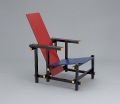 Gerrit Rietveld, Red Blue Chair, 1918-1923, Credit: MoMA, Gift of Philip Johnson
 -
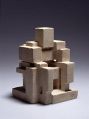 Georges Vantongerloo, Rapports de volumes, 1919, Source: WikiArt.org
 -
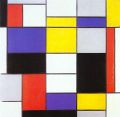 Piet Mondrian, Composition A, 1923, Source: WikiArt.org
 -
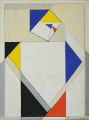 Vilmos Huszar, Composition with Female Figure, 1918, Credit: MoMA, The Riklis Collection of McCrory Corporation
 -
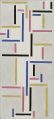 Theo van Doesburg, Rhythm of a Russian Dance, June 1918, Credit: MoMA, Acquired through the Lillie P. Bliss Bequest (by exchange)


Additional Resources
Museum Collections
Kunstmuseum Hague has the most extensive Mondrian collection
Stedelijk Museum (Amsterdam) has many works by Rietveld and van Doesburg
Central Museum of Utrecht has the largest Rietveld collection worldwide
Kröller-Müller Museum has masterpieces by Mondrian, van Doesburg, Rietveld, and Van der Leck
Videos
De Stijl Movement: Art and Architecture Revolution, InSite YouTube channel, June 26, 2024, https://m.youtube.com/watch?v=swIZI_QUY1g
De Stijl - Piet Mondrian and Theo van Doesburg, 20th Century, Vivie’s Art World, May 14, 2025, https://www.youtube.com/watch?v=QQ8GDjoWUfY
Websites
Museum of Modern Art, https://www.moma.org/collection/terms/de-stijl
Neoplasticism - Part I, An explanation of Mondrian’s oeuvre by Michael Sciam, https://www.piet-mondrian.eu/introduction/an-overview/a-new-plastic-language/
Guggenheim New York, https://www.guggenheim.org/artwork/movement/de-stijl
Rietveld-Schroeder House, Architect Gerrit Rietveld, Utrecht, Netherlands, 1924, UNESCO World Heritage Convention, https://whc.unesco.org/en/list/965/
Notes
- ↑ See https://en.wikipedia.org/wiki/De_Stijl
- ↑ Theo van Doesburg, Piet Mondrian, Vilmos Huszar, Georges Vantongerloo, Jan Wils, Robert van ‘t Hoff, and Gerrit Rietveld signed the manifesto. See https://www.christies.com/en/stories/collecting-guide-de-stijl-art-movement-fb74945aafd748ffae465f4a08884d83
- ↑ "Chronologies: Artists and the Spiritual", Judi Freeman, The Spiritual in Art: Abstract Painting 1890-1985, as organized by Maurice Tuchman, Los Angeles County Museum of Art, p. 397.}
- ↑ See https://en.wikipedia.org/wiki/De_Stijl
- ↑ “The Birth of De Stijl, Part II, Bart van der Leck”, Rudolf W. Oxennar, https://www.artforum.com/features/the-birth-of-de-stijl-part-two-bart-van-der-leck-210291/
- ↑ See https://www.museothyssen.org/en/collection/artists/huszar-vilmos
- ↑ "Chronologies: Artists and the Spiritual", Judi Freeman, The Spiritual in Art: Abstract Painting 1890-1985, as organized by Maurice Tuchman, Los Angeles County Museum of Art, p. 419.
- ↑ See https://en.wikipedia.org/wiki/J._J._P._Oud and https://www.britannica.com/biography/Jacobus-Johannes-Pieter-Oud
- ↑ See https://en.wikipedia.org/wiki/Gerrit_Rietveld and https://www.britannica.com/biography/Gerrit-Thomas-Rietveld
- ↑ See https://en.wikipedia.org/wiki/Robert_van_'t_Hoff
- ↑ See https://en.wikipedia.org/wiki/Antony_Kok#:~:text=Antony%20Kok%20(1882–1969),the%20avant%2Dgarde%20visual%20arts.
- ↑ See https://www.christies.com/en/stories/collecting-guide-de-stijl-art-movement-fb74945aafd748ffae465f4a08884d83
- ↑ See https://www.christies.com/en/stories/collecting-guide-de-stijl-art-movement-fb74945aafd748ffae465f4a08884d83
- ↑ See https://www.christies.com/en/stories/collecting-guide-de-stijl-art-movement-fb74945aafd748ffae465f4a08884d83
- ↑ See https://en.wikipedia.org/wiki/Cornelis_van_Eesteren
- ↑ "Annunciation of the New Mysticism: Dutch Symbolism and Early Abstraction", Carel Blotkamp, Spiritual in Art: Abstract Painting 1890-1985, as organized by Maurice Tuchman, Los Angeles County Museum of Art, p. 104-105.
- ↑ "Chronologies: Artists and the Spiritual", Judi Freeman, The Spiritual in Art: Abstract Painting 1890-1985, as organized by Maurice Tuchman, Los Angeles County Museum of Art, p. 397.
- ↑ Letter from Mondrian to van Doesburg, n.d., probably May 1918, quoted in Hoek, “Piet Mondrian”, p. 59 as cited in Carel Blotkamp's "Annunciation of the New Mysticism: Dutch Symbolism and Early Abstraction", The Spiritual in Art: Abstract Painting 1890-1985, as organized by Maurice Tuchman, Los Angeles County Museum of Art, p. 103.
- ↑ "Sacred Geometry: French Symbolism and Early Abstraction", Robert P. Welsh, The Spiritual in Art: Abstract Painting 1890-1985, as organized by Maurice Tuchman, Los Angeles County Museum of Art, p. 84.
- ↑ Mondrian: His Life, His Art, His Quest for the Absolute, Nicholas Fox Weber, New York, 2024, Alfred A. Knopf Publisher, p. 226
- ↑ Mondrian: His Life, His Art, His Quest for the Absolute, Nicholas Fox Weber, New York, 2024, Alfred A. Knopf Publisher, p. 261.