User:SysopJ/My sandbox: Difference between revisions
| Line 8: | Line 8: | ||
The Ponds sought to create a modern American architecture without rejecting architectural stylistic traditions, but simplifying them through the emphasis of geometry and the inherent quality of building materials and construction. In that regard, the Ponds were strongly influenced by the Arts and Crafts movement, with the emphasis on honest materials used honestly.<ref>David Swan, Preface to ''The Autobiography of Irving K. Pond: The Sons of Mary and Eliihu'' ed.David Swan and Terry Tatum (Oak Park, Ill: The Hyoogen Press, 2009), vii.</ref> | The Ponds sought to create a modern American architecture without rejecting architectural stylistic traditions, but simplifying them through the emphasis of geometry and the inherent quality of building materials and construction. In that regard, the Ponds were strongly influenced by the Arts and Crafts movement, with the emphasis on honest materials used honestly.<ref>David Swan, Preface to ''The Autobiography of Irving K. Pond: The Sons of Mary and Eliihu'' ed.David Swan and Terry Tatum (Oak Park, Ill: The Hyoogen Press, 2009), vii.</ref> | ||
</blockquote> | </blockquote> | ||
Strong sense of social responsibility | |||
Stylistically Irving Pond did not totally fit in one category or another. He stood in the role of an | |||
intermediary, halfway between the revolutionary aesthetics and technology of the Chicago | |||
School and the Prairie School and the taste for traditional architecture his clients often felt that | |||
precedent or literary aesthetics required.8 His architecture used traditional materials especially | |||
brick and employed traditional forms such as gable roofs, but his designs embraced a geometric | |||
simplicity with no embellishments—a tenet of the Arts & Crafts movement. - from Ravinia School nomination | |||
=== Gallery of architectural projects === | === Gallery of architectural projects === | ||
Revision as of 22:04, 20 March 2026
Irving Kane Pond (1857-1939) and his brother Allen Bartlitt Pond (1858–1929)
Personal life
Architectural work
The Ponds sought to create a modern American architecture without rejecting architectural stylistic traditions, but simplifying them through the emphasis of geometry and the inherent quality of building materials and construction. In that regard, the Ponds were strongly influenced by the Arts and Crafts movement, with the emphasis on honest materials used honestly.[1]
Strong sense of social responsibility
Stylistically Irving Pond did not totally fit in one category or another. He stood in the role of an intermediary, halfway between the revolutionary aesthetics and technology of the Chicago School and the Prairie School and the taste for traditional architecture his clients often felt that precedent or literary aesthetics required.8 His architecture used traditional materials especially brick and employed traditional forms such as gable roofs, but his designs embraced a geometric simplicity with no embellishments—a tenet of the Arts & Crafts movement. - from Ravinia School nomination
Gallery of architectural projects
-
 Michigan Union, 1919
 -
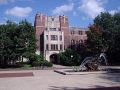 Michigan League, 1929


Writings
- The Meaning Of Architecture: An Essay In Constructive Criticism. Boston, Marshall Jones Company, 1918. 226 pages, illustrations. Available at Hathitrust and several versions at Internet Archive.
- "Eliel Saarinen and his work a word of appreciation and greeting". 1923. Available at and [https://babel.hathitrust.org/cgi/pt?id=mdp.39015008062880&seq=1 Hathitrust. Pages extracted from The Western Architect 32 no. 7 (July, 1923): 75-76 plus plates.
- A Day Under the Big Top, a Study in Life and Art. Chicago: Chicago Literary Club, 1924. 40 pages, with 4 diagrams. "Edition, five hundred and fifteen copies, printed for members of the club in the month of March, nineteen hundred and twenty-four." About circus and acrobatics. Available at Google Books and Hathitrust.
- The College Union. [New York], 1931. 16 pages. Limited availability at Hathitrust and Google Books.
- "Pullman - America's First Planned Industrial Town". Illinois society of architects. Monthly bulletin vol. 18-19, nos. 12-1, June-July, 1934. 6-8 pages.
- Big Top Rhythms: A Study in Art and Life, written and illustrated by Pond. Chicago, New York, Willett, Clark and Company, 1937. 229 pages, illustrations.
- A Strange Fellow, and Other Club Papers, written and illustrated by Pond New York, Chicago, Priv. Print. by Willett, Clark and Company, 1938. 224 pages, illustrations. Available at Hathitrust, Open Content Alliance, and Internet Archive.
- The Autobiography of Irving K. Pond, written in the 1930s and published posthumously. Edited by Terry Tatum and David Swan. Oak Park, IL: Hyoogen Press, 2009.
Additional resources
Articles
- Szuberla, Guy. "Iring Kane Pond: a Michigan Architect in Chicago" Old Northwest 5 no. 2 (Summer, 1979): 109-140.
Books
Archival collections
Notes
- ↑ David Swan, Preface to The Autobiography of Irving K. Pond: The Sons of Mary and Eliihu ed.David Swan and Terry Tatum (Oak Park, Ill: The Hyoogen Press, 2009), vii.